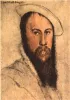
Birth date
1503
Death date
1542
Birth town
Kent
Country
England
Poems by this Poet
Displaying 211 - 220 of 308
Thomas Wyatt was born at Allington Castle in Kent, and educated at St John's College, Cambridge. While travelling as a diplomat for Henry VIII he developed his interest in Continental poetry; he was the first English poet to use the Italian forms of the sonnet and terza rima, and the French rondeau. His translation of the Penitential Psalms is based on a version by the Italian poet Pietro Aretino.
In the course of his career Wyatt served his King Henry in a variety of offices, including those of Marshal of Calais, Sheriff of Kent and Ambassador to Spain, and he was also jailed several times. His first imprisonment, in 1534, was for brawling; two years later his relationship with the disgraced Anne Boleyn resulted in a short spell in the Tower of London. Thomas and Anne had been lovers before her marriage to Henry, and his sense of loss at their separation forms the subject of the famous sonnet 'Whoso List To Hunt'.
Wyatt was restored to favour and knighted in 1537, and spent the next two years on his embassy to the court of Charles V of Spain. In 1540 however, his trusted patron Thomas Cromwell was executed, leaving him without an ally at court. The following year Wyatt was accused of treason by his enemies and imprisoned in the Tower once more. He managed to secure his own release but died of a fever soon afterwards.
In the course of his career Wyatt served his King Henry in a variety of offices, including those of Marshal of Calais, Sheriff of Kent and Ambassador to Spain, and he was also jailed several times. His first imprisonment, in 1534, was for brawling; two years later his relationship with the disgraced Anne Boleyn resulted in a short spell in the Tower of London. Thomas and Anne had been lovers before her marriage to Henry, and his sense of loss at their separation forms the subject of the famous sonnet 'Whoso List To Hunt'.
Wyatt was restored to favour and knighted in 1537, and spent the next two years on his embassy to the court of Charles V of Spain. In 1540 however, his trusted patron Thomas Cromwell was executed, leaving him without an ally at court. The following year Wyatt was accused of treason by his enemies and imprisoned in the Tower once more. He managed to secure his own release but died of a fever soon afterwards.